
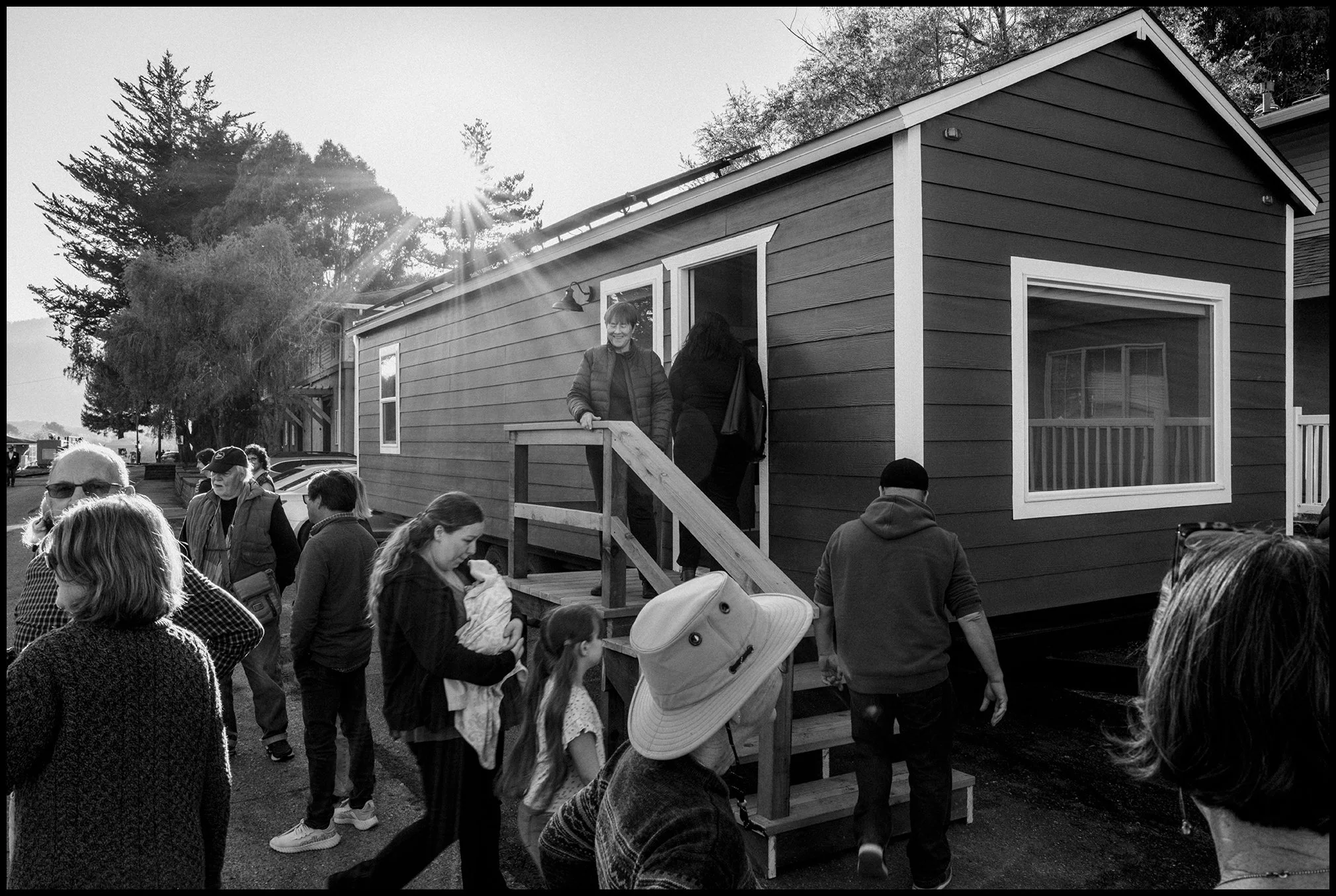
On Friday, the Community Land Trust Association of West Marin debuted one of the tiny homes meant to house displaced residents of the Point Reyes National Seashore. (David Briggs / Point Reyes Light)
By Ben Stocking. Reprinted with permission from the Point Reyes Light
The Community Land Trust Association of West Marin, a small nonprofit facing a massive housing challenge, has located enough units for over half the 40 families facing displacement from West Marin ranches, and it has targeted several more that it hopes to soon add to its pipeline.
The county approved a lease agreement with the nonprofit last week, and CLAM began preliminary work at the so-called calf lot at Sixth and B Streets. With $1.4 million allocated by supervisors to support the operation of the Point Reyes Station site, CLAM is racing to have 14 tiny homes ready as interim housing by March 1, when residents must leave the Point Reyes National Seashore.
CLAM held an open house at the Coast Guard property on Friday, the same day the first two tiny homes arrived. The units are being stored at the site while the calf lot is readied, and attendees got a tour and heard updates by executive director Jarrod Russell.
So far, apart from its efforts at the Coast Guard property, the trust has raised more than half the $20 million to $30 million it needs to implement plans for rapidly housing the displaced residents.
“We are well over halfway, but we still need help,” Mr. Russell said. “This is the time for everybody to keep leaning in so that we keep delivering housing for these families.”
Since late summer, CLAM has purchased three properties, including a triplex in Point Reyes Station, a duplex in Forest Knolls and a four-bedroom house in Tomales. It expects to purchase another home in Point Reyes Station shortly and is looking closely at several other properties around Tomales Bay.
The nonprofit closed on the Tomales property on Friday and the Forest Knolls property in late October. Two displaced families—one from the seashore and one from the Martinelli ranch—have moved into the Point Reyes triplex, which was purchased in August.
As many as six additional apartments are slated for a renovated Sacred Heart Church rectory in Olema, which the Archdiocese of San Francisco is negotiating with CLAM on a long-term lease.
In all, the land trust is trying to find housing for 156 displaced people. About 50 of them lived in trailers at the Martinelli ranch north of Point Reyes Station, where the county declared the rental housing unfit for habitation a year and a half ago. The remainder are being displaced by the settlement of a lawsuit that is ending most ranching in the seashore.
The calf lot could house about a third of the displaced families. The houses CLAM has already purchased, along with others it hopes to buy soon, could house another third, Mr. Russell said. CLAM is also eyeing a single multi-unit property that could accommodate the remaining third, though he declined to provide details before a deal is consummated.
“We’re being asked to try to house more people in the next year than we’ve housed over the last 20,” he said. “That is the challenge and road ahead. I’m happy to report that we’re making tremendous progress.”
The tiny home on display last Friday was designed to meet the requirements of the Americans with Disabilities Act. At 410 square feet, it is indeed tiny, but it has one bedroom, a large bathroom and a combined kitchen and living space. Painted forest green, the unit has five windows and a small cedar stairway leading to a mustard-colored door. It rests on a set of eight wheels; its lack of a permanent foundation qualifies it as temporary housing. A set of solar panels across the roof should provide all the power necessary to heat the unit and keep the lights and appliances running, according to Tom McCafferty, the land trust’s director of properties.
All the tiny homes, designed by a company in Pacifica, are the same size. They are equipped with washing machines, heat pumps, compact kitchen appliances and small TV screens in the bedroom and sitting room. A large kitchen window provides ample sunlight. They come in two shades of green and two shades of blue.
Though the A.D.A. units have just one bedroom, the regular units, which have a smaller bathroom and kitchen and living spaces, squeeze in two.
The county purchased the calf lot this year with the intention of leasing it to CLAM for interim housing. Under the lease and operating agreements approved last week, CLAM will manage the homes—which are together designated as a “housing-based homeless shelter”—until March 11, 2028.
The lot would provide a maximum of 26 bedrooms and could be developed with permanent affordable housing in the future. CLAM’s agreement includes “good neighbor” provisions requiring residents to observe quiet hours, leash their pets and properly dispose of trash.
The supervisors voted 4-0 in favor of the project. Supervisor Dennis Rodoni recused himself because he co-owns a property within a mile of the lot.
Attorney Ed Yates spoke on behalf of some calf lot neighbors, asking the county to slow down the pace of the project and reduce the number of homes. He asserted that the project requires an environmental review under the California Environmental Quality Act, and he warned that people from outside town could inhabit the homes if not enough locals apply.
“They could be homeless people from San Rafael or Richmond who could be substance abusers, and this is next to a senior community, a grammar school and a preschool,” said Mr. Yates, who represented a small group of Bolinas residents who unsuccessfully sought to block the Bo-Linda Vista emergency housing project there.
Brian Halter, a deputy county attorney, said the calf lot project falls under an emergency shelter resolution passed by supervisors last March. The declaration eased some zoning and environmental review rules to expedite temporary housing solutions.
Ashley Eagle-Gibbs, executive director of the Environmental Action Committee of West Marin, spoke in favor of the project, although she argued that any permanent affordable housing at the site should be subject to CEQA requirements.
“Besides its amazing natural beauty, what makes West Marin so amazing for both locals and visitors is the vibrant community and all the individuals who contribute to it,” she said. “I would like these people who are being displaced to be able to continue living and working in the community and attending the schools.”
Under the emergency shelter declaration, displaced ranch families would be first in line for all housing that CLAM is rushing to get online by March 1. Familias Afectadas de Rancho, a group advocating for the seashore tenants, has been pressing for an extension of that deadline.
Some families have already left town, fearing they may have no place to go if they wait, but families who have departed will be welcomed back, Mr. Russell said. “They might still have their kids in school here, or they might still work here,” he said. “CLAM is committed to making sure that they have a pathway back to this community.”
CLAM’s efforts have been supported by a coalition of local nonprofits and religious institutions. “It’s heroic that CLAM actually has so many units of interim and permanent housing in the pipeline,” said Cassandra Benjamin, an affordable housing consultant who directed a study of West Marin’s urgent housing needs last year. “It usually takes years and years for affordable housing to happen.”
