Eviction deadline looms for last farmworker families in Point Reyes

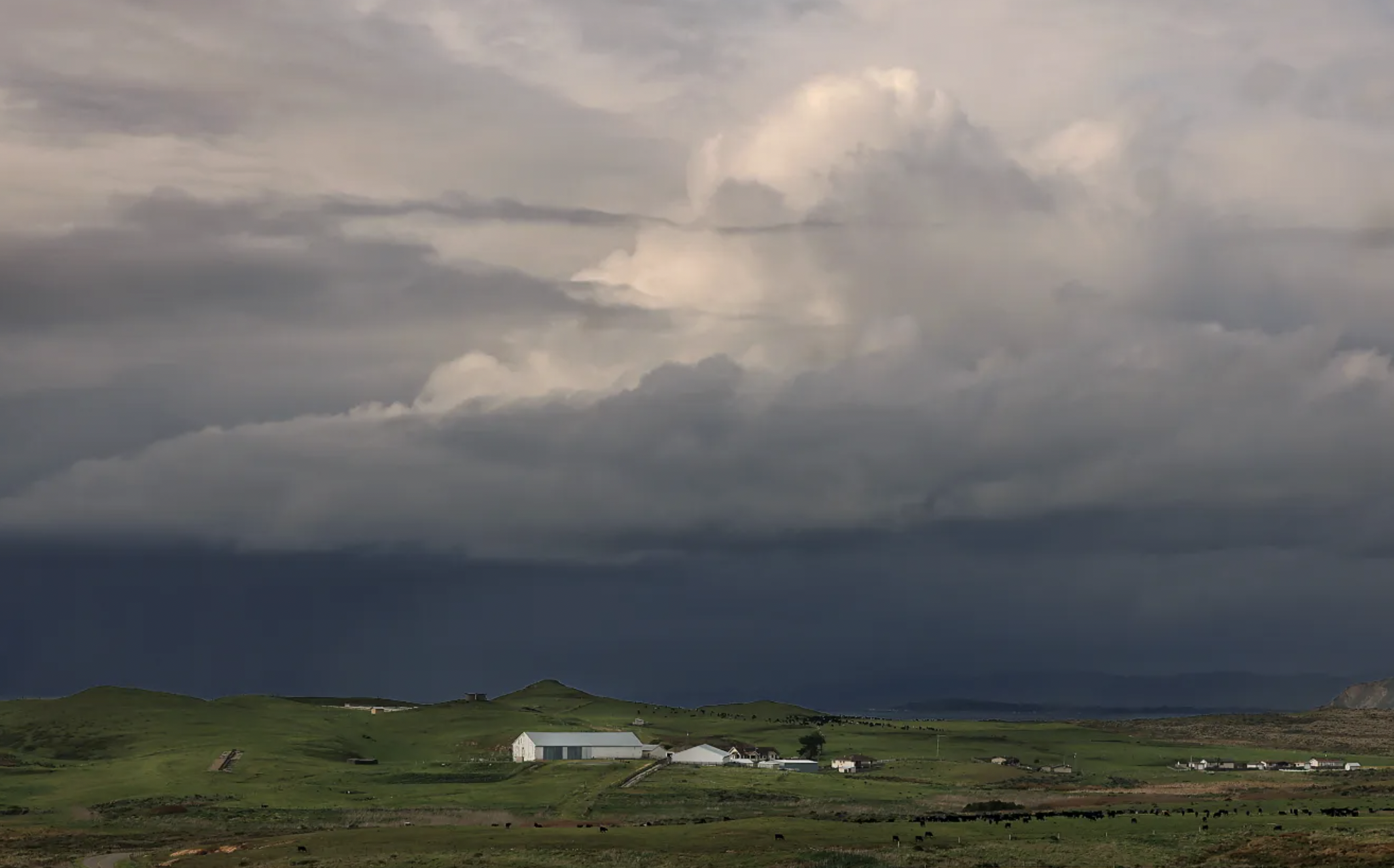
A thunderstorm rumbles over McClure Ranch at Point Reyes National Seashore. Save for just a few farmworkers still to placed in housing, the ranch is non operational, Wednesday, Feb. 18, 2026. (Kent Porter / The Press Democrat)

By John Beck. Please read the full article here.

After scrambling for months to find a new home before a Saturday eviction deadline, one last farmworker family in Point Reyes National Seashore is running out of time and may have to move into a hotel or short-term vacation rental as a last-ditch option.

“I’m honestly scared,” said Margarito Loza.

He and his wife, Chabela, have lived at Spaletta Dairy for 35 years. Their 17-year-old son, Tony, is midway through his senior year at Tomales High School and is deeply concerned about where he will live next week and the toll the upheaval has taken on his family.

“I worry about my parents,” he said. “I really wanted to graduate from Tomales this year, but I know it’s really hard for them to make that happen.”

Last Thursday, several seashore families at the former McClure Dairy faced the same deadline, with nowhere to go, when they received a late-hour reprieve granting one-month extensions. Another family at the former McClelland Dairy is still awaiting a response to its extension request.

For the Lozas, however, an extension was never an option. Margarito said the ranch owners made it clear he must move out by midnight Saturday, Feb. 28.

A landmark settlement, and its fallout

There were 26 farmworker and tenant families living in the seashore last January when a landmark settlement between environmental organizations and ranchers ended most ranching in the park. The agreement set a deadline of Feb. 28, 2026, for all ranch tenants to leave; ranch owners agreed to vacate land many had farmed for generations by April 8, 2026.

If the mood then was one of uncertainty, it has since turned into a race against the clock. The nonprofit Community Land Trust Association of West Marin, known as CLAM, has been working through the rainy season to build a makeshift community of 14 tiny homes or trailers at the corner of Sixth and B Streets in Point Reyes Station, on a vacant property long known as the “Calf Lot.”

By Monday, 10 homes were in place. But they will not be ready by Saturday’s deadline.

“April is looking promising,” said Jarrod Russell, CLAM’s executive director, adding that progress depends largely on the weather.

The site, funded largely by $1.1 million from the County of Marin, is expected to house seven families from Point Reyes ranches and seven from nearby Martinelli Ranch, where a similar housing crisis is unfolding.

It is a spectacle Point Reyes Station has never seen before, with locals snapping photos of wide-load trucks hauling tiny homes along narrow rural roads. Two weeks ago, many farmworkers and tenant families held a moving sale in a school parking lot, selling clothes, shoes, books, toys, furniture and kitchenware they could not bring with them.

Secret deal, staggered departures

Last August, the first wave of farmworker families began leaving the Point as transition support payments were issued by The Nature Conservancy, the conservation group brought in by North Coast Rep. Jared Huffman and others to resolve a mediation deadlock.

In a confidential deal bound by nondisclosure agreements, The Nature Conservancy paid an estimated $30 million to 12 ranch and dairy owners who agreed to shut down operations that predated the park. The agreement settled a lawsuit brought by environmental plaintiffs alleging that ranching operations were contaminating water, degrading air quality and harming local habitats.

Some families, after finding new jobs, left Marin County. Others struggled to remain in West Marin’s tight and costly housing market. One family moved to Santa Rosa, even as the mother continued teaching in San Anselmo and two children made the long daily commute to Tomales High.

Two weeks ago, five families were still without housing: the Lozas at Spaletta Dairy, three families at the former McClure Dairy, and one at the former McClelland Dairy.

On Jan. 19, Jasmine Bravo, co-founder of Las Familias Afectadas de Rancho, a grassroots advocacy group, sent a request for extensions on behalf of four families to Rodd Kelsey, the California land program director for The Nature Conservancy, who is overseeing transition efforts in Point Reyes.

“We heard nothing back,” Bravo said early last week. Her mother and sister live in one of the last remaining houses at the McClure ranch. “One of those families has a medical emergency they’re dealing with, and they would have a very hard time moving right now.”

After weeks without acknowledgment, Bravo said she met with Kelsey last Thursday and was told the three families at McClure ranch would receive one-month extensions, pushing their deadline to March 31. The family at the McClelland ranch is still waiting for a response.

Kelsey declined to discuss details publicly, referring questions to Kaitlyn Abbott, head of strategic communications for The Nature Conservancy’s Pacific Division.

“We recognize this is an incredibly difficult time for the departing families, involving deeply personal, life-altering transitions,” Abbott wrote in an emailed statement. She said The Nature Conservancy is providing the equivalent of 18 months’ rent in West Marin to support families’ next steps, but is not responsible for housing placements.

“The official move-off deadline is Feb. 28, 2026, for households to remain eligible for transition support payment,” she added.

A community mobilizes

In response, CLAM and a network of West Marin nonprofits, including the West Marin Fund, West Marin Community Services, North Marin Community Services and the Marin Community Foundation, have coordinated an unusually rapid housing effort in a region where affordable development typically takes years.

“This is its own form of a humanitarian crisis,” Russell said. “We’re not the Red Cross, but together the community is stepping up to do something that is normally a seemingly intractable and very slow process — affordable housing.”

Over the last seven months, backed by at least $15 million in private donations and additional county and foundation funding, CLAM has purchased multiple properties: a 2-acre parcel in Tomales, a duplex in Lagunitas-Forest Knolls, a triplex in Point Reyes Station and a single-family home in Point Reyes acquired through a deal with the local water district. Six families — 25 people in total — have been housed on those properties. Two additional projects are under contract in Inverness and Point Reyes Station.

So far, roughly $21 million has been raised toward a $27 million goal, said Tom McCafferty, CLAM’s director of properties.

Meanwhile, a “Neighbors for Neighbors” program, a collaboration among West Marin Fund, West Marin Community Services and the County of Marin, has placed several families in temporary bridge housing on properties with available space.

“It’s amazing to see that it’s only been a year since the settlement announcement and there are this many housing units in the hopper,” said Cassandra Benjamin, lead author of the 2024 West Marin Housing Study and a housing consultant for the Marin Community Foundation. “Affordable housing usually takes six to eight years. This is Herculean.”

Still searching for a home

And yet, as the deadline nears, the Lozas remain without a permanent place to live.

“Chabela keeps asking, ‘What’s going to happen to us?’” Margarito said. “And what can I tell her?”

Tony, with three months until graduation, presses for answers of his own.

Summer Cassell, the county’s West Marin municipal services manager and a Tomales High graduate, has worked closely with the family. She understands why they want to stay.

“With Margarito’s family, they have Tony in school, so they don’t want to leave,” she said. “A lot of families have lived here for decades and feel very safe, very comfortable here. In my opinion, if they want to stay here, they should be able to.”

Cassell said the most viable short-term options include a hotel with a shared kitchen in Tomales, a short-term rental near Point Reyes Station or possibly space offered by a charitable organization in San Rafael.

Margarito, 59, has not worked for six months after being told there was no more work at Spaletta Dairy. After more than three decades of milking cows twice daily, he has struggled to find a new position, competing with younger ranch hands. The $8,000 his family received last August from The Nature Conservancy — 10% of their transition support payment — has been spent. The remaining 90% is contingent on vacating by the deadline.

Since he stopped working, his weight has risen from 180 to 220 pounds, he said.

“Closing the ranch definitely hurt me,” he said. “If you’re used to working and suddenly you stop moving, your body gets sick.”

At his lowest moments, he speaks in despair. But he continues searching.

Two weeks ago, the family began moving belongings into a storage unit in Petaluma. They declined housing offers in Bolinas and Lagunitas-Forest Knolls because the commute would be too long for Tony. Margarito inquired about vacant seashore homes once occupied by workers connected to the shuttered Drakes Bay Oyster Company but was told they were unavailable.

On Sunday, after services at Sacred Heart Church in Olema, a stranger offered what Margarito called a miracle: temporary housing in a house near Point Reyes Station until CLAM can secure something more permanent.

“I only know him by sight, but he’s helping us a lot,” Margarito said. “I hope we can move this weekend, but I don’t know.”

Even if the move comes through, another hurdle remains: work. Chabela continues cleaning houses. Margarito is still looking for a job.

Pausing, he recited a line from the ranchera classic “Paloma Negra,” written years before he was born in Jalostotitlán, Mexico, where he met his wife.

“I’m tired of crying,” he said softly, “and the dawn never breaks.”

Raquel Issenberg contributed to this story. 

Next
Next

Neighbors for Neighbors: A response to displacement