
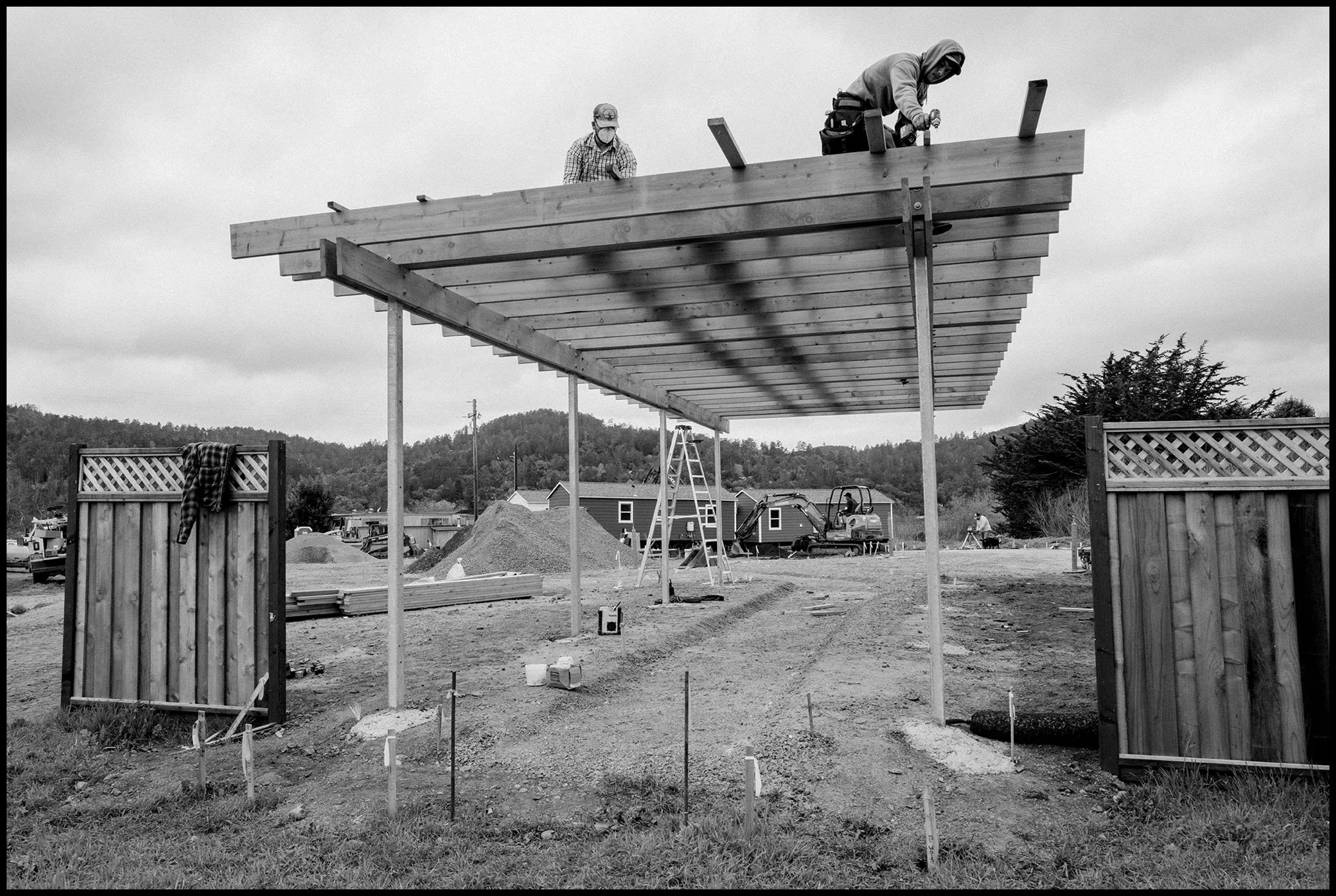
CLAM has delivered four tiny homes to a lot in Point Reyes Station that will soon house 14. The project, swiftly funded and executed to serve the needs of displaced families, is expected to be finished by April. Above, work crews construct an entry pergola. (David Briggs / Point Reyes Light)
By Sophia Grace Carter. Reprinted with permission from the Point Reyes Light
The first tiny homes rolled into Sixth and B Streets in Point Reyes Station late last week. By Tuesday, four of the planned 14 units stood along an edge of the lot, a small but tangible sign of progress for families facing eviction from the Point Reyes National Seashore in just 16 days.
Dozens of residents must vacate by March 1 under a settlement that shut down most farms in the park.
The homes are being installed by the Community Land Trust Association of West Marin, which is racing to secure housing for over 150 people displaced from the seashore and the nearby Martinelli ranch, where the county declared the homes unfit for habitation.
“As long as the weather continues to give us beautiful days and sunshine, there’s no reason we shouldn’t be done toward the end of March,” said Patrick Lunny, who grew up on the historic G Ranch and is serving as the project’s general contractor. “We’re doing everything we can to make that happen, like working Saturdays to try to gain some time.”
Each tiny home measures 410 square feet and includes one or two bedrooms; the units are fully furnished and roof-top solar panels are expected to power heaters, lights and appliances. The units each cost the land trust about $157,000, and rent will be $1,250 per month.
Of the 50 or so displaced households, CLAM has helped six families move into permanent homes, while roughly 10 are in temporary arrangements. Twenty-five families remain on ranches, and another 10 left West Marin.
About five households in the seashore remain in limbo. Most are families that are too large to be accommodated by the tiny homes. Instead, CLAM is negotiating to acquire two properties with a total of seven units that could be available by the end of the month. But the trust faces a $6 million fundraising gap, according to Tom McCafferty, its director of properties.
“If we succeed in this last fundraising effort, we could have those families in by the end of the month,” he said. The nonprofit has raised $21 million out of the $27 million needed to rehouse every household. “Without some major commitments in the next few weeks, CLAM is going to be in a hard spot, deciding whether or not to close on these final two properties.”
The project at Sixth and B Streets is partly backed by a $2 million congressional earmark secured by Rep. Jared Huffman. Approved as part of a narrowly passed federal spending package, the money is intended to help convert the temporary units into permanent housing. (Rep. Huffman ultimately voted against the bill, which funded Homeland Security through Feb. 13.)
Seashore tenants say time is running out. “There are households who wish to stay locally but haven’t found housing,” said Jasmine Bravo, an organizer. “We’re putting out a call for short-term rentals. It’s not a matter of whether the housing exists—it does—it’s that it’s not accessible.”
For months, park residents have urged the Nature Conservancy to extend their moveout deadline. “Just one month would be incredibly helpful to ensure households are not displaced outside of West Marin,” Ms. Bravo said. “We’ve lost enough families to this settlement, but unfortunately, the Nature Conservancy has not been responsive to us.”
The Nature Conservancy, which financed the ranch buyouts, did not respond to a request for comment.
As moving day nears, families are beginning to downsize. Ranch residents will hold a yard sale at West Marin School on Saturday, selling household goods along with food and drink.
Andrew Giacomini, the attorney representing 40 ranch residents challenging their eviction, said he has been mired in bureaucratic limbo while trying to secure extensions, including for one family dealing with a medical emergency.
“We’re caught in a dilemma,” he said. “I’ve asked the lawyers for [the Nature Conservancy] and the park service if we can get an extension for some people, but they say I need to talk to the ranchers. So I call the rancher’s lawyer, and he says he’s amenable to a short extension but that we need permission from the park service.”
Mr. Giacomini plans to refile his lawsuit, which a judge dismissed last month. Meanwhile, another suit brought by two ranching families is in mediation. They argue that the pastoral zone was congressionally designated for agriculture and that the park service must preserve it as part of the region’s cultural heritage.
“Our clients are looking to the future of the seashore,” their attorney, Peter Prows, said. “We are hopeful we can reach a resolution that provides for a better future for ranching than [was] reached last year.”